AI Superagents in HR: Why 2026 Is the Tipping Point
How agentic AI is eliminating routine tasks and redefining what recruiters actually do
AI superagents are redefining HR in 2026, automating up to 30% of recruiter tasks. Discover why talent leaders are racing to adopt agentic AI and what it means for the future of hiring.
The recruitment industry is standing at a crossroads. On one side, the familiar world of manual sourcing, endless resume screening, and calendar Tetris. On the other, a new paradigm powered by AI superagents that can autonomously manage entire hiring workflows from end to end. In 2026, this is no longer a theoretical debate — it is the lived reality of thousands of talent acquisition teams worldwide.
According to Korn Ferry's 2026 Talent Acquisition Trends Report, over 52% of talent leaders are actively planning to integrate AI agents into their recruitment operations this year. Gartner predicts that by end of 2026, agentic AI will handle at least 30% of tasks currently performed by human recruiters across mid-to-large enterprises. The tipping point has arrived.
What Exactly Are AI Superagents — and How Do They Differ from Traditional AI?
Traditional AI in recruitment has existed for years — resume parsing software, basic chatbots that answer FAQs, or algorithms that rank candidates based on keyword matching. These tools are helpful, but they operate in silos and require constant human oversight. As we explored in our deep dive on how agentic AI is revolutionizing hiring in 2026, the shift to truly autonomous systems represents a fundamental change in how recruitment teams operate.
AI superagents, by contrast, are autonomous systems that can orchestrate complex, multi-step workflows without human intervention at each stage. They combine large language models with decision-making frameworks, memory systems, and tool-use capabilities. A superagent does not just screen a resume — it sources the candidate from multiple platforms, evaluates their profile against the job requirements, crafts a personalized outreach message, sends it, follows up if needed, schedules the interview, and prepares a briefing document for the hiring manager. All of this happens while the recruiter focuses on building relationships and making strategic decisions.
Think of it this way: traditional AI is like having a smart calculator. An AI superagent is like having a junior recruiter who never sleeps, never forgets a follow-up, and gets faster with every interaction. The difference is not incremental — it is transformational.
The 30% Role Shift: What Tasks Are Being Automated?
Research from McKinsey and Deloitte consistently highlights that approximately 30% of a recruiter's daily workload consists of repetitive, process-driven tasks that are prime candidates for automation. Our own analysis of the hidden cost of interview chaos found that recruiters spend an average of 10+ hours per week on coordination tasks alone — time that AI superagents can reclaim almost entirely.
The tasks most commonly being absorbed by AI superagents include initial candidate sourcing across LinkedIn, job boards, and internal databases; first-pass resume screening and qualification assessment; interview scheduling, rescheduling, and calendar coordination across multiple time zones; candidate communication including status updates, rejection notifications, and follow-up nudges; reference check initiation and automated follow-ups; job description optimization based on market data and performance analytics; and pipeline reporting and candidate status tracking.
But the story here is not about job loss. When AI absorbs the 30% of repetitive tasks, recruiters do not become obsolete — they become more valuable. The remaining 70% of their role shifts toward strategic activities that genuinely require human judgment: consultative partnership with hiring managers, employer brand storytelling, complex salary negotiations, diversity strategy, and candidate experience design. As we detailed in our post on why AI-powered pre-screening saves more than just time, the real savings extend far beyond efficiency into quality-of-hire improvements that fundamentally change business outcomes.
Why 2026 Is the Tipping Point: Five Converging Forces
The question many leaders are asking is: why now? After all, AI has been a buzzword in HR for years. The answer lies in five forces that have converged simultaneously in 2026, creating conditions that make widespread adoption not just possible, but inevitable.
First, large language models have reached the reliability threshold. The models powering today's superagents produce communication that is virtually indistinguishable from human writing. Candidates receiving AI-crafted outreach messages respond at rates equal to or higher than human-written messages, because the personalization is more thorough and consistent. Second, integration infrastructure has matured. APIs connecting AI superagents to major Applicant Tracking Systems like Greenhouse, Lever, Workday, and iCIMS are now robust and well-documented. What used to require months of custom engineering now takes days to set up, dramatically lowering the barrier to entry for mid-market companies.
Third, the persistent talent shortage is forcing innovation. With unemployment in key tech and healthcare sectors hovering near record lows, companies simply cannot hire fast enough using traditional methods. AI superagents allow lean recruiting teams to manage 2-3x the volume without proportional headcount increases. Fourth, proven ROI from early adopters is building confidence. Companies that piloted AI agents in 2024 and 2025 are now publishing detailed case studies and trend analyses showing measurable returns, giving hesitant organizations the confidence to invest. And fifth, candidate expectations have evolved — today's job seekers expect fast, transparent, and personalized communication, exactly what AI superagents deliver at scale.
Real-World Impact: The Numbers Behind the Transformation
The data from organizations that have deployed AI superagents in production is striking. According to aggregated benchmarks from SHRM's 2026 Talent Acquisition research and several major HR tech vendors, the results tell a consistent story across industries and company sizes.
Time-to-fill has decreased by 40 to 60 percent on average. A role that previously took 45 days to fill is now being closed in 18-25 days. Candidate response rates have improved by 3x due to hyper-personalized outreach that references specific projects, skills, and career interests — something no human recruiter could do at scale for hundreds of candidates simultaneously. Recruiter productivity has effectively doubled, with each recruiter managing 2 to 3 times more open requisitions while reporting lower stress levels and higher job satisfaction.
Cost-per-hire has dropped by 25 to 35 percent, driven primarily by reduced agency dependency and faster fill rates that lower vacancy costs. Perhaps most surprisingly, candidate satisfaction scores have actually increased — debunking the widespread fear that automation creates a cold, impersonal experience. In reality, candidates appreciate faster responses, more consistent communication, and the transparent process that AI-powered workflows provide.
Skills-Based Hiring and AI Superagents: A Natural Partnership
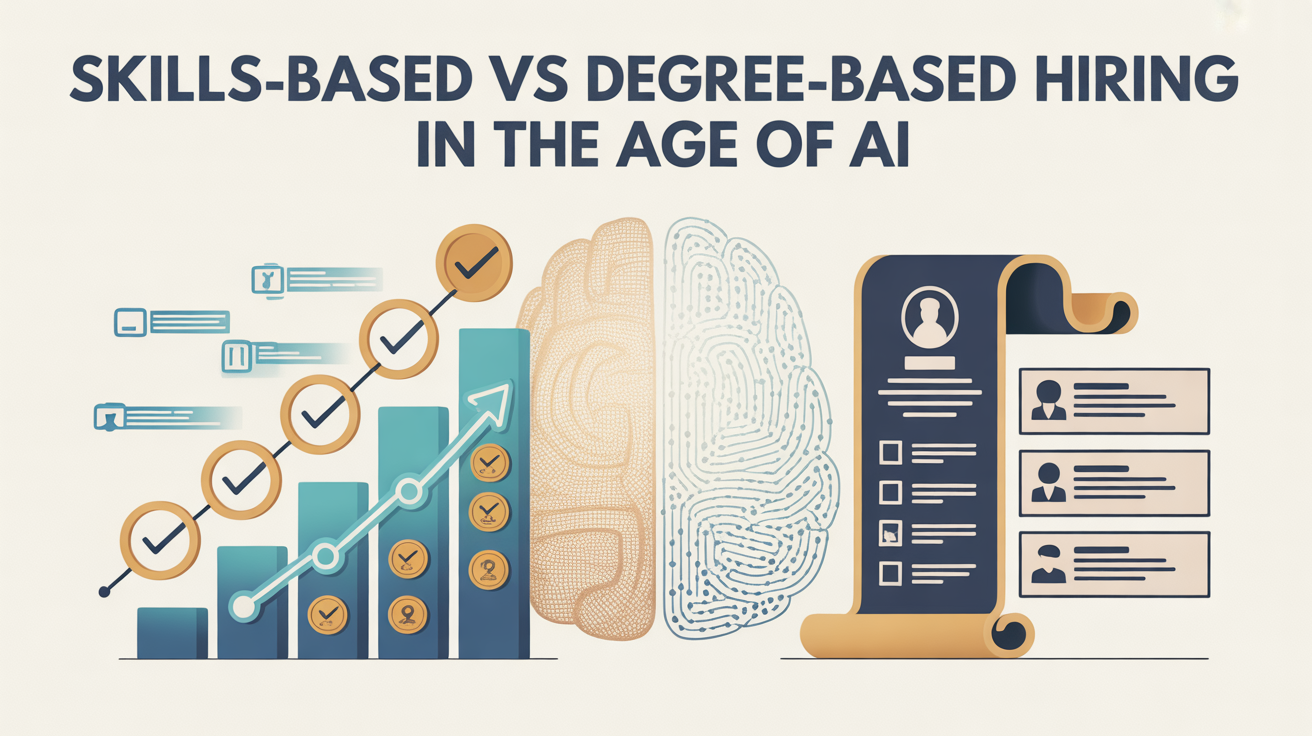
One of the most exciting applications of AI superagents is in skills-based hiring, which is quickly becoming the dominant paradigm in 2026. Traditional hiring relies heavily on proxies like degrees, job titles, and years of experience. But these are imperfect indicators of actual capability. AI superagents can analyze candidate profiles holistically — evaluating GitHub contributions, portfolio work, certifications, project descriptions, and even communication patterns — to build a rich skills profile that goes far beyond what a resume reveals.
This is closely connected to the rise of semantic AI in talent discovery, where natural language understanding allows AI to match candidates to roles based on the meaning of their experience rather than keyword overlap. A software engineer who has never held the title "DevOps Engineer" might still be a perfect fit if their actual work involved infrastructure automation, CI/CD pipeline management, and cloud architecture. AI superagents identify these nuanced matches at a scale and speed impossible for human recruiters working manually.
The Intelligent Sourcing Revolution
Perhaps nowhere is the impact of AI superagents more visible than in candidate sourcing. Traditional sourcing involves manually searching LinkedIn, writing Boolean strings, and scrolling through profiles — a process that is both time-consuming and limited by human attention span. As we explored in our guide to intelligent candidate sourcing with AI, modern AI-powered sourcing tools can scan millions of profiles across dozens of platforms simultaneously, identifying candidates who match not just the job description but the team culture, growth trajectory, and compensation expectations.
AI superagents take this even further by learning from every interaction. When a sourced candidate responds positively, the agent updates its model of what a strong candidate looks like for that role. When a candidate declines, the agent learns from the reason and adjusts future targeting. Over time, these feedback loops create increasingly precise sourcing that dramatically reduces wasted effort and improves pipeline quality. Companies using AI-powered sourcing report that the percentage of sourced candidates who advance to the interview stage has increased from an industry average of 15% to over 35% — a transformative improvement in efficiency.
How to Prepare Your HR Team for the Superagent Era
For talent leaders looking to stay ahead of this transformation, preparation is essential. Here are six actionable steps to get your team ready for the superagent era.
First, audit your current workflow to identify the 30% of tasks ripe for automation. Map every step of your recruitment process from job requisition to offer acceptance. Flag every task that is repetitive, rule-based, or primarily administrative. These are your automation candidates. Be honest about where your team spends time versus where they add unique value. Second, invest in upskilling your recruiters. The skills that made a great recruiter in 2020 are not the same skills that will matter in 2027. Focus on developing capabilities in talent strategy and workforce planning, data literacy and analytics interpretation, consultative selling and stakeholder management, employer brand development, and diversity, equity, and inclusion strategy.
Third, choose AI tools that integrate with your existing tech stack rather than requiring a complete overhaul. The best AI superagent platforms are designed to work alongside your current ATS, CRM, and communication tools. As our analysis of how AI agents cut time-to-hire without cutting corners demonstrated, the most successful implementations build on existing infrastructure rather than replacing it entirely.
Fourth, establish clear governance policies around AI-driven candidate communication and decision-making. Define what AI can do autonomously versus what requires human approval. Create transparency standards so candidates know when they are interacting with AI. Build bias auditing into your process from day one. Fifth, start small with a pilot program. Choose one role type or one team to test AI superagent capabilities before rolling out organization-wide. This allows you to learn, iterate, and build internal champions. Sixth, measure everything. Set clear KPIs before implementation — time-to-fill, candidate satisfaction, cost-per-hire, offer acceptance rate, quality of hire — and track them rigorously through the transition.
The Ethical Dimension: Responsible AI in Recruitment
No discussion of AI superagents in HR would be complete without addressing the ethical considerations. Bias in AI systems remains a legitimate concern, and responsible deployment requires proactive measures. Algorithms must be regularly audited for disparate impact across protected categories. Training data must be reviewed for historical biases that could be perpetuated. Candidate consent and transparency must be prioritized. And human oversight must be maintained for consequential decisions like final hiring choices and offer terms. The agentic revolution making traditional ATS platforms obsolete brings with it a responsibility to build better, fairer systems — not just faster ones. The organizations getting this right view AI governance not as a compliance burden but as a competitive advantage, signaling to candidates and employees that they take fairness and equity seriously.
The Bottom Line: Elevating, Not Replacing
AI superagents are not replacing recruiters. They are elevating them. The organizations that thrive in 2026 and beyond will be those that embrace this technology as a force multiplier — allowing their human talent teams to operate at a strategic level that was previously impossible given the administrative burden of traditional recruitment. The 30% of tasks being automated are precisely the tasks that recruiters have long complained about: the tedious, repetitive, low-value work that consumes their days and prevents them from doing what they were actually hired to do.
The question is no longer whether AI will transform HR recruitment. It is whether your organization will lead that transformation or scramble to catch up. The tipping point is here, the technology is proven, and the early movers are already reaping the rewards. The best time to start was yesterday. The second best time is today. If you are ready to explore how AI-powered recruitment can transform your hiring process, visit TheHireHub to learn how we are helping companies hire smarter, faster, and more equitably in the age of agentic AI.
Frequently Asked Questions
What is an AI superagent in HR?
An AI superagent is an autonomous system that can orchestrate entire recruitment workflows, from sourcing candidates to scheduling interviews, unlike traditional AI tools that handle only single tasks. They combine large language models with decision-making frameworks and tool-use capabilities to work independently.
Will AI superagents replace human recruiters?
No. AI superagents automate roughly 30% of routine tasks like sourcing, screening, and scheduling, allowing recruiters to focus on higher-value work like strategic talent advisory, employer branding, complex negotiations, and candidate experience design.
What results are companies seeing from AI superagents?
Early adopters report 40-60% faster time to fill, 3x improvement in candidate response rates, doubled recruiter productivity, and 25-35% reduction in cost per hire. Candidate satisfaction scores have also increased.
How can my HR team prepare for AI superagents?
Start by auditing your workflows for automatable tasks, invest in upskilling recruiters in strategy and data literacy, choose AI tools that integrate with your existing ATS, establish clear governance policies, pilot with one team first, and measure KPIs rigorously before and after implementation.