The Onboarding Gap: How AI Is Turning New Hires Into Top Performers 3x Faster
Why the biggest ROI in talent management isn't in hiring—it's in what happens after the offer letter.
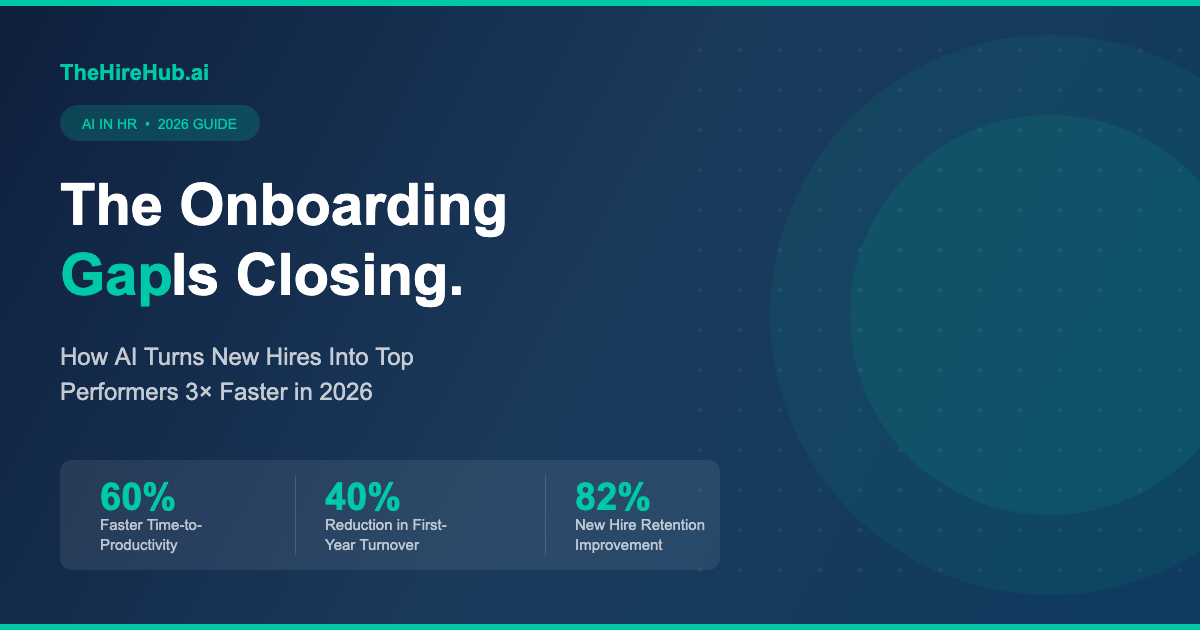
Most companies obsess over AI in hiring, but ignore the moment that defines real ROI: onboarding. In 2026, AI-powered onboarding platforms are slashing time-to-productivity by up to 60%, reducing first-year turnover by 40%, and giving HR leaders real-time visibility into new hire readiness. Here is how the best companies are closing the onboarding gap—and why it matters more than your ATS.
Every year, organizations spend billions perfecting their recruitment pipelines—investing in AI-powered sourcing tools, automated screening platforms, and predictive analytics to find the perfect hire. And yet, the moment the offer letter is signed, most of that intelligence disappears. The new employee walks into an avalanche of paperwork, generic orientation sessions, and a 90-day sink-or-swim period that determines whether the hire was a success—or a costly mistake.
This is the onboarding gap: the dangerous chasm between the sophistication of modern hiring and the primitive state of most onboarding programs. According to Gallup, only 12% of employees strongly agree that their organization does a great job onboarding new employees. And the price of getting it wrong is staggering—companies lose up to 20% of new hires within the first 45 days, and it costs between 50–200% of an employee's annual salary to replace them.
But in 2026, a growing number of forward-thinking organizations are closing this gap with AI-powered onboarding. The results are remarkable: time-to-productivity reduced by up to 60%, first-year retention improved by 30–40%, and new hires reaching full performance benchmarks weeks—sometimes months—ahead of schedule.
The True Cost of Broken Onboarding
Before exploring the solution, it's worth understanding the full weight of the problem. Poor onboarding doesn't just create unhappy employees—it creates a cascading financial and cultural crisis.
The Numbers Don't Lie
The Society for Human Resource Management (SHRM) estimates that organizations spend an average of $4,100 per new hire on onboarding—yet most of that investment fails to translate into measurable performance outcomes. The problem is structural: traditional onboarding is static, one-size-fits-all, and designed around the organization's convenience rather than the new hire's learning curve.
A study by BambooHR found that 31% of employees have quit a job within the first six months. More tellingly, 23% of those who left said that clearer guidelines about their responsibilities would have made them stay. And 17% cited the need for a friendlier onboarding experience. These are not complex cultural problems—they are process failures that AI is uniquely equipped to solve.
The Hidden Time Tax
Beyond turnover, there is a productivity drain that rarely makes it into boardroom conversations. The average new employee takes between 8 and 26 weeks to reach full productivity, depending on role complexity. During that window, they consume manager time, make costly errors, and occupy a position without fully delivering on it. For senior or technical roles, that ramp period can stretch to a full year.
In a market where speed and performance matter more than ever, that is a competitive handicap organizations can no longer afford.
Why Traditional Onboarding Fails in 2026
The root cause of the onboarding gap is simple: traditional onboarding was designed for a different era. It assumes all new hires learn at the same pace, need the same information, and respond to the same kind of support. None of those assumptions are true.
The Cookie-Cutter Problem
Most onboarding programs deliver a fixed sequence of activities: HR paperwork on Day 1, a company overview on Day 2, a department introduction on Day 3, and so on. This calendar-based approach ignores the fact that different new hires have vastly different starting points. A senior engineer who has worked in similar roles for a decade has very different onboarding needs than a recent graduate joining their first enterprise team.
When onboarding is generic, high-potential employees disengage quickly. They feel underestimated, overlooked, and—most dangerously—they start to question whether they have joined the right company.
The Feedback Void
Traditional onboarding also suffers from a feedback void. HR teams rarely have real-time visibility into how new hires are progressing. Check-ins happen weekly at best, often as perfunctory conversations that fail to surface genuine challenges. By the time a new hire's struggles become visible—when deadlines are missed or manager frustration escalates—it is often too late to intervene effectively.
The Manager Bottleneck
In most organizations, onboarding success depends almost entirely on a new hire's direct manager. But managers are not onboarding specialists. They are managing existing teams, hitting quarterly targets, and juggling competing priorities. The expectation that managers can simultaneously run their departments and deliver a world-class onboarding experience to each new team member is simply unrealistic.
How AI Is Closing the Onboarding Gap
This is where artificial intelligence fundamentally changes the equation. AI does not replace the human elements of onboarding—mentorship, culture immersion, relationship building—but it systematizes, personalizes, and accelerates everything around them.
Personalized Learning Pathways
The most transformative application of AI in onboarding is personalized learning. AI systems can analyze a new hire's background, role requirements, skill gaps (often identified during the hiring process), and learning preferences to generate a truly customized onboarding journey.
Instead of sitting through a four-hour compliance training that covers topics they already mastered in a previous role, a new hire receives a targeted curriculum that fills their specific gaps. The AI continually adjusts this pathway based on how quickly the employee completes modules, their assessment performance, and engagement patterns. Early results from platforms investing in AI-driven personalization show a 40–55% reduction in time-to-competency for roles with structured learning requirements.
Real-Time Progress Monitoring and Early Intervention
Perhaps the most valuable capability AI brings to onboarding is real-time visibility into new hire readiness. Instead of waiting for the 90-day review to discover that a new hire is struggling, AI systems continuously monitor signals—completion rates, assessment scores, peer interaction patterns, and sentiment analysis from communication tools—to flag at-risk employees before problems escalate.
This early warning system gives HR teams and managers the opportunity to intervene precisely and promptly. If an AI system detects that a new hire has not engaged with key process documentation in their third week, it can automatically surface that alert to their manager and offer a contextual nudge—a suggested resource, a check-in prompt, or a recommendation to pair the employee with a specific mentor.
TheHireHub.ai, which has been at the forefront of AI-powered talent intelligence, emphasizes that the data generated during the hiring process—skills assessments, behavioral signals, and capability profiles—can and should flow seamlessly into onboarding systems, creating a continuous intelligence layer that guides a new hire's entire first year.
Intelligent Q&A and Always-On Support
New hires have hundreds of questions in their first weeks. Most of them go unasked, because the new employee does not want to appear incompetent, their manager is unavailable, or they simply do not know who to ask. These unanswered questions create confusion, slow progress, and quietly erode confidence.
AI-powered onboarding assistants solve this problem by providing 24/7, contextually intelligent support. These are not simple FAQ chatbots—they are large language model-powered systems trained on the company's knowledge base, policies, procedures, and org charts. A new hire can ask 'Who do I contact for a software license request?' or 'What is the approval process for travel expenses?' and receive an accurate, instant response at any hour.
According to Deloitte's 2025 Human Capital Trends report, organizations that deploy AI onboarding assistants see a 65% reduction in repetitive HR queries and a measurable improvement in new hire confidence scores within the first 30 days.
Automated Compliance and Documentation
The administrative burden of onboarding is substantial and largely unrewarding—for both HR teams and new hires. AI-powered onboarding platforms can automate the collection, verification, and filing of compliance documentation, background check coordination, equipment provisioning workflows, and policy acknowledgments.
This automation does not just save time—it reduces risk. Compliance documentation errors and missed acknowledgments create legal exposure for organizations. AI systems with built-in compliance workflows ensure nothing falls through the cracks, maintaining audit trails and escalating any outstanding items automatically.
Predictive Performance Forecasting
Advanced AI onboarding platforms are now moving beyond process automation into predictive intelligence. By analyzing patterns from successful employees across similar roles, these systems can generate early performance forecasts for new hires—predicting which employees are likely to excel, which may need additional support, and even which are at risk of early exit.
This predictive layer allows HR leaders to make proactive, data-driven interventions rather than reactive ones. It also provides valuable calibration data for talent acquisition teams—creating a feedback loop between hiring decisions and onboarding outcomes that continuously improves the quality of hiring criteria.
The Business Case: ROI You Can Measure
For HR leaders making the case for AI onboarding investment, the ROI story is compelling and measurable.
Reduced Time-to-Productivity
Organizations that have implemented AI-powered onboarding consistently report reductions in time-to-full-productivity of 30–60%. For a senior role that previously took six months to ramp, this translates directly to three additional months of full-contribution performance—a value that typically ranges from $30,000 to $150,000 per hire, depending on seniority and compensation.
First-Year Retention Uplift
The Aberdeen Group found that organizations with a strong onboarding process improve new hire retention by 82% and productivity by over 70%. With AI-powered onboarding delivering consistently stronger experiences, first-year attrition rates in early adopter organizations have dropped by 25–40%.
At an average replacement cost of 50–200% of annual salary, a retention improvement of just five percentage points across a cohort of 100 new hires can generate seven-figure savings annually. The math for AI onboarding investment is rarely difficult to make.
Manager Time Reclaimed
When AI handles the routine, repetitive elements of onboarding—answering FAQ questions, tracking document completion, sending follow-up reminders, providing progress updates—managers reclaim meaningful hours each week. Studies suggest that managers in organizations without AI onboarding support spend 30–40% more time on administrative onboarding tasks than those with AI-powered systems. That freed-up time can be redirected toward the high-value human elements of onboarding: building relationships, providing strategic context, and coaching for growth.
Implementation: What Good AI Onboarding Looks Like in Practice
Understanding the value proposition is one thing. Building an AI-powered onboarding capability that actually delivers requires careful design and integration.
Start with Data Integration
Effective AI onboarding begins at the point of hire, not the first day on the job. The most advanced organizations are creating bidirectional data flows between their applicant tracking systems, talent intelligence platforms, and onboarding systems—so that the capability profiles, behavioral assessments, and skills gap data generated during hiring automatically inform the onboarding journey.
Platforms like TheHireHub.ai are pioneering this integrated approach, ensuring that the intelligence gathered during the hiring process is not wasted the moment an offer is accepted. A new hire's onboarding pathway can be pre-built before they walk through the door on Day 1, personalized to their exact profile.
Design for the Role, Not the Organization
AI onboarding programs should be designed around role-specific milestones and competencies, not generic corporate timelines. Define what 'fully productive' looks like for each role—the specific skills mastered, relationships built, and deliverables achieved—and let AI guide each new hire toward those milestones at their optimal pace.
Maintain the Human Core
The most effective AI onboarding programs use technology to amplify human connection, not replace it. AI handles the logistics, tracks the progress, and surfaces the insights—but the mentorship, the culture conversations, and the relationship building remain human-led. The sweet spot is a hybrid model where AI takes care of what machines do best—consistency, scale, and 24/7 availability—freeing humans to do what they do best: empathy, inspiration, and judgment.
Measure What Matters
Implement onboarding analytics from day one. Track time-to-first-milestone, 30/60/90-day engagement scores, manager satisfaction ratings, and first-year retention rates by cohort. These metrics will allow you to continuously refine your AI onboarding program and demonstrate clear ROI to leadership.
What's Next: The Future of AI Onboarding
The technology is evolving rapidly. In the next 12–18 months, we can expect several developments that will further reshape what onboarding looks like.
Multimodal AI onboarding assistants that can guide new hires through complex technical setups using voice and video, not just text interfaces, will make onboarding feel more like working with a knowledgeable colleague than navigating a help center.
Integration with simulation technology will allow new hires to practice difficult scenarios—challenging client conversations, leadership decisions, compliance situations—in safe, AI-powered environments before facing them in reality.
Predictive cultural fit monitoring will identify early signals of alignment or misalignment with team dynamics, allowing managers to proactively build bridges before disengagement sets in.
Cross-organizational benchmarking will let HR leaders compare their onboarding performance metrics against industry peers and identify specific areas where their programs underperform—bringing the same competitive intelligence lens to talent development that already exists in talent acquisition.
The organizations that move early on these capabilities will not just onboard faster—they will build a structural talent advantage that compounds over time.
Closing the Gap—Before You Lose the Hire
The onboarding gap is not inevitable. It is a process failure—and one that AI is uniquely positioned to solve. Organizations that continue to invest in sophisticated hiring technology while leaving onboarding to chance are making a costly mistake: they are doing the hard work of finding great talent, then failing to convert that investment into sustained performance.
The competitive advantage of the next decade will not belong only to companies that hire better. It will belong to companies that onboard smarter—that turn the first 90 days from a high-risk period into a genuine launchpad for long-term performance and loyalty.
In 2026, the tools to do this exist, the data supports the investment, and the ROI is clear. The only question is which organizations will move fast enough to close the gap before their best new hires decide to leave.
Sources & References
1. Gallup (2024). State of the American Workplace Report. gallup.com
2. SHRM (2025). Onboarding New Employees: Maximizing Success. shrm.org
3. BambooHR (2024). The Definitive Guide to Employee Onboarding. bamboohr.com
4. Deloitte (2025). Global Human Capital Trends Report. deloitte.com
5. Aberdeen Group (2024). Onboarding 2024: Organizational Alignment Report. aberdeen.com
6. SHRM (2025). Employee Turnover and Retention Report. shrm.org
Frequently Asked Questions
What is AI-powered onboarding and how does it differ from traditional onboarding?
AI-powered onboarding uses artificial intelligence to personalize, automate, and optimize the new hire experience. Unlike traditional onboarding—which follows a fixed, calendar-based schedule regardless of the individual's background—AI onboarding analyzes each employee's skills, experience, and learning patterns to create a customized journey. It monitors progress in real time, provides 24/7 support through intelligent assistants, automates compliance workflows, and flags at-risk employees before problems escalate. The result is a faster, more engaging, and significantly more effective onboarding experience.
How much can AI onboarding reduce time-to-productivity for new hires?
Research and early adopter data consistently show that AI-powered onboarding can reduce time-to-full-productivity by 30–60%, depending on role complexity and the maturity of the AI system deployed. For a senior role that previously took six months to ramp, this could mean three additional months of full-contribution performance per hire—translating to $30,000–$150,000 in additional value per employee, depending on seniority and compensation level.
What ROI can HR leaders expect from investing in AI onboarding technology?
The ROI from AI onboarding comes from three primary sources: reduced time-to-productivity (saving the cost of an extended ramp period), improved first-year retention (reducing replacement costs that can reach 50–200% of annual salary), and reclaimed manager time (freeing up 30–40% of administrative onboarding hours). Organizations that have implemented AI onboarding report 82% improvements in new hire retention and productivity gains exceeding 70%, according to Aberdeen Group research. A retention improvement of just five percentage points across a cohort of 100 new hires can generate seven-figure annual savings.
Does AI onboarding replace the need for human connection during the onboarding process?
No—and this is a critical distinction. The most effective AI onboarding programs are designed to amplify human connection, not replace it. AI handles the logistics, tracking, compliance automation, and 24/7 Q&A support—everything machines do well at scale. This frees managers and HR teams to focus on what humans do best: mentorship, culture building, relationship development, and strategic coaching. The ideal model is a hybrid approach where technology takes care of consistency and scale, while people deliver empathy and inspiration.
How does AI onboarding connect to the hiring process?
The most advanced AI onboarding platforms create a seamless data flow from the hiring process into onboarding. Skills assessments, behavioral profiles, and capability gap data gathered during recruitment automatically inform the new hire's onboarding pathway—so their learning journey is personalized before they even walk through the door on Day 1. Platforms like TheHireHub.ai are pioneering this integrated approach, ensuring that the intelligence gathered during hiring is not wasted the moment an offer is accepted.
What are the biggest risks of ignoring AI onboarding in 2026?
Organizations that fail to modernize their onboarding risk three compounding problems: high early-stage attrition (losing up to 20% of new hires within 45 days), extended productivity ramp periods (costing tens of thousands per hire in lost output), and manager burnout from carrying the entire onboarding burden without systemic support. As competitors adopt AI onboarding and consistently outperform on new hire retention and time-to-productivity, organizations relying on traditional approaches will face a growing talent disadvantage. In a market where great people have choices, a poor onboarding experience is often the last impression a company makes.