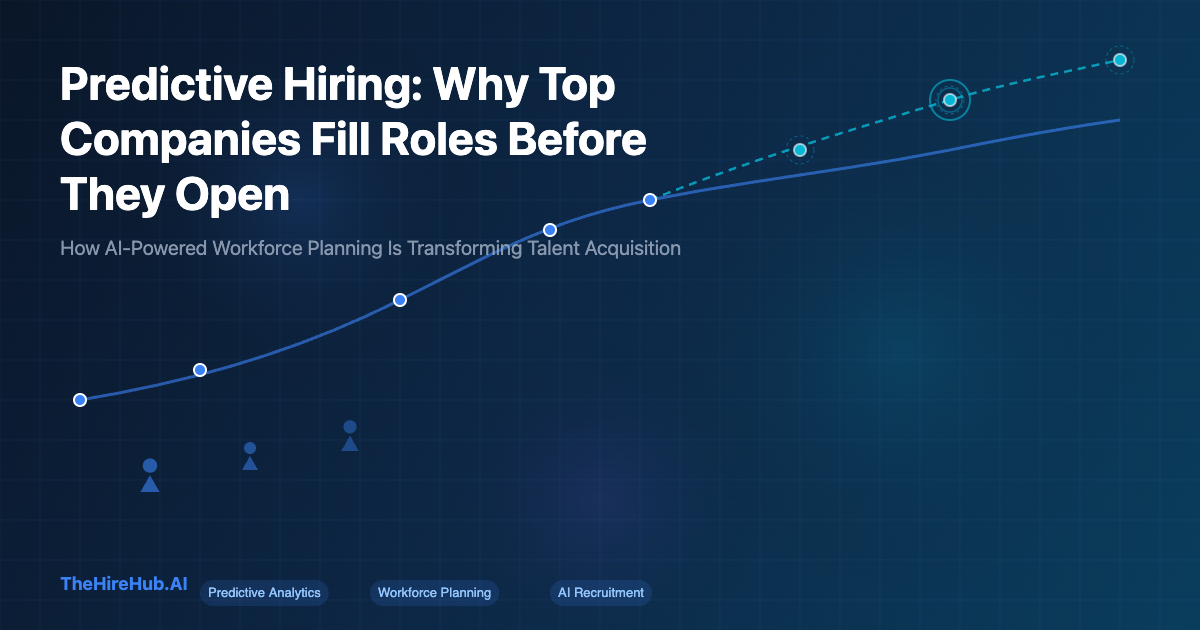
Predictive Hiring: Why Top Companies Fill Roles Before They Open
How AI-powered workforce planning is shifting recruitment from reactive firefighting to strategic talent acquisition in 2026
Discover how AI-powered predictive hiring is helping top companies forecast staffing needs months in advance, reducing time-to-fill by up to 50% and transforming recruitment from reactive scrambling into strategic workforce planning.
Introduction: The Shift From Reactive to Predictive Hiring
For decades, the default mode of recruitment has been reactive. A position opens up, a job description gets posted, and the scramble to fill the role begins. Recruiters race against time, sifting through hundreds of applications while hiring managers grow increasingly frustrated with empty seats draining team productivity. According to the Society for Human Resource Management (SHRM), the average time-to-fill a role in 2025 was 44 days, and for technical positions, it often stretched past 60 days.
But what if you could see a vacancy coming months before it appeared? What if your recruitment engine started warming up candidates, building pipelines, and pre-qualifying talent before anyone even submitted a resignation letter? That is the promise of predictive hiring, and in 2026, it is no longer science fiction. It is the operational reality at forward-thinking companies worldwide.
Predictive hiring uses artificial intelligence, machine learning models, and historical workforce data to forecast staffing needs before they become urgent. Rather than reacting to a departure or a new project mandate, predictive hiring empowers talent acquisition teams to stay perpetually ahead of the curve. And it is rapidly becoming the single most transformative trend in HR technology this year.
What Exactly Is Predictive Hiring?
Predictive hiring is an AI-driven approach to talent acquisition that leverages data analytics, attrition modeling, and business forecasting to anticipate hiring needs well in advance. Instead of waiting for a role to open, predictive hiring systems continuously analyze signals such as employee engagement scores, tenure patterns, project pipeline data, market trends, and even macroeconomic indicators to estimate when and where new hires will be needed.
Think of it as weather forecasting for your workforce. Just as meteorologists use atmospheric data to predict storms days ahead, predictive hiring platforms use organizational data to predict talent gaps weeks or months in advance. The result is a proactive, always-on recruitment engine that builds candidate pipelines before a requisition is even created.
Key Components of a Predictive Hiring System
A robust predictive hiring system typically integrates several core elements. Attrition prediction models analyze historical turnover data to identify which roles, departments, or tenure bands are most likely to experience departures. Growth forecasting modules connect to business planning data, such as sales pipeline, product roadmaps, or expansion plans, to predict new headcount needs. Talent pool scoring continuously evaluates passive candidates in your pipeline and ranks them based on fit and availability. And intelligent scheduling algorithms determine the optimal time to initiate outreach so that candidates are engaged and warm exactly when a position opens.
Why 2026 Is the Tipping Point for Predictive Hiring
Several converging factors make 2026 the year predictive hiring breaks into the mainstream. First, AI models have reached a level of maturity where they can process complex workforce signals with high accuracy. According to a 2026 Deloitte Global Human Capital Trends report, organizations that intentionally redesign how humans and AI collaborate are significantly more likely to exceed their performance targets.
Second, data infrastructure has caught up. Most mid-to-large enterprises now have connected HRIS, ATS, and workforce analytics platforms that generate the structured data predictive models need. Gartner research from early 2026 indicates that over 80 percent of HR departments are now using some form of generative AI or predictive analytics in their daily operations.
Third, the economic reality demands it. With hiring costs escalating and talent markets remaining competitive in key sectors like AI engineering, cybersecurity, and healthcare, companies can no longer afford the luxury of reactive hiring. The cost of a bad hire averages over 17,000 dollars per mistake according to recent industry estimates, and the cost of an unfilled critical role can exceed 500 dollars per day in lost productivity.
Fourth, the competitive pressure is undeniable. Organizations that adopt predictive hiring gain a first-mover advantage in securing scarce talent. When your competitor begins sourcing for a role three months before it opens while you wait until the position is vacant, the talent war is already lost before it begins. Early adopters of predictive hiring report that they consistently beat competitors to top candidates, particularly in high-demand fields like machine learning engineering and data science.
The Business Case: How Predictive Hiring Saves Time and Money
The ROI of predictive hiring is compelling. Organizations implementing predictive workforce planning report dramatic improvements across key recruitment metrics. Time-to-fill drops significantly because candidate pipelines are pre-built for roles that are statistically likely to open. Quality of hire improves because there is more time for thorough evaluation rather than rushed decisions driven by urgency.
Reduced Time-to-Fill
When your system identifies that a senior engineer role has a 73 percent probability of opening in Q3 based on historical attrition patterns and the current team member reaching their median tenure threshold, your recruiting team can begin sourcing and engaging candidates two to three months early. By the time the role officially opens, you already have a shortlist of vetted, interested candidates. Companies using predictive hiring report time-to-fill reductions of 30 to 50 percent compared to traditional reactive approaches.
Lower Cost-Per-Hire
Urgency is expensive. When a role needs to be filled immediately, recruiters often resort to costly job board boosting, premium agency fees, or inflated compensation offers to attract candidates quickly. Predictive hiring eliminates this urgency premium. By starting the process earlier, organizations can rely more heavily on organic sourcing channels, employee referrals, and talent community nurturing, all of which are significantly cheaper than paid channels.
Improved Quality of Hire
Perhaps the most significant advantage is quality. When recruiters are not under pressure to fill a role yesterday, they can be more selective, conduct more thorough assessments, and take the time to ensure cultural and technical fit. A 2026 Korn Ferry study found that companies with proactive talent pipelines reported 40 percent higher hiring manager satisfaction compared to those relying on reactive posting-and-praying methods.
How AI Powers Predictive Hiring in Practice
At the heart of predictive hiring are AI models trained on a combination of internal workforce data and external market signals. Here is how the technology works in practice.
Attrition Risk Scoring
Machine learning models analyze factors like employee tenure, promotion history, compensation relative to market rates, engagement survey responses, and even communication pattern changes to assign a flight risk score to each employee. When an individual crosses a threshold, say a 65 percent probability of departure within the next 90 days, the system automatically triggers a sourcing workflow for their role. This is not about surveilling employees. It is about ensuring business continuity by being prepared.
Demand Forecasting
Beyond attrition, predictive systems analyze business growth signals. If your sales pipeline shows a 40 percent increase in enterprise deals closing next quarter, the model can estimate how many additional customer success managers, implementation engineers, or support staff will be needed. By connecting recruitment planning directly to business data, predictive hiring aligns talent acquisition with strategic growth in real time.
Talent Pool Warm-Up
Once a future need is identified, AI-powered engagement tools begin nurturing candidates from your talent pool. Personalized content, thought leadership articles, company updates, and role-specific information are shared with potential candidates to keep them engaged. Platforms like TheHireHub.ai excel at this, using agentic AI to autonomously manage candidate outreach and engagement, ensuring your pipeline stays warm and conversion-ready.
Real-World Applications Across Industries
Predictive hiring is not limited to tech giants with massive data science teams. It is being adopted across industries with compelling results.
Technology and SaaS
Engineering roles in AI, cloud computing, and cybersecurity are notoriously difficult to fill. Tech companies using predictive hiring are building always-on pipelines for high-demand roles, reducing dependency on expensive contingency recruiters. Some leading SaaS companies have reduced their external agency spend by more than 60 percent by shifting to predictive models.
Healthcare
The healthcare industry faces chronic staffing shortages, particularly in nursing and specialized care. Predictive models that factor in seasonal demand, regulatory changes, and retirement projections are helping hospital systems maintain adequate staffing levels without the crisis-driven overtime costs that have plagued the sector.
Financial Services
Banks and fintech companies are using predictive hiring to stay ahead of compliance-driven hiring needs. When new regulations are announced, predictive models can estimate the additional compliance, risk, and audit headcount needed and begin sourcing before the mandate takes effect.
Getting Started: A Practical Roadmap for Predictive Hiring
Transitioning from reactive to predictive hiring does not require a complete technology overhaul. Here is a practical roadmap for organizations looking to make the shift.
Step 1: Audit Your Data Foundation
Predictive models are only as good as the data they consume. Start by evaluating the quality and completeness of your HRIS, ATS, and workforce analytics data. Ensure you have at least two to three years of clean historical data on hires, departures, tenure, and performance. If gaps exist, begin addressing them now so that your models have solid foundations.
Step 2: Start With Attrition Prediction
Attrition prediction is typically the quickest win. Most organizations already have the necessary data, including tenure, compensation history, promotion timelines, and exit interview records. Begin by building or deploying a basic attrition model for your highest-turnover roles and use the predictions to trigger early sourcing for those positions.
Step 3: Connect Business Planning Data
The next level of sophistication involves connecting your recruitment planning to business forecasting data. Work with finance, sales, and operations teams to access pipeline data, growth projections, and strategic plans. This allows your predictive models to forecast not just replacements but also net new roles.
Step 4: Deploy AI-Powered Engagement
Once you can predict needs, you need the tools to act on those predictions. This is where AI-powered recruitment platforms become essential. TheHireHub.ai, for example, combines predictive intelligence with agentic AI that autonomously manages candidate sourcing, screening, and engagement. The platform can automatically begin building a shortlist for a predicted opening, saving your recruiters hours of manual work.
Step 5: Measure and Iterate
Track the accuracy of your predictions and continuously refine your models. Start measuring prediction accuracy, the percentage of predicted openings that actually materialize, and the time advantage gained. Most organizations find that their models improve significantly after six to twelve months of operation as they accumulate more data and feedback loops.
The Role of Responsible AI in Predictive Hiring
As predictive hiring becomes more prevalent, responsible AI governance is essential. With the EU AI Act now classifying employment-related AI systems as high-risk, organizations must ensure their predictive models are transparent, auditable, and free from discriminatory bias. This means regular bias audits, explainable model outputs, and human oversight at key decision points.
The good news is that well-designed predictive hiring systems can actually reduce bias compared to traditional hiring. By relying on objective data signals rather than gut feelings or resume-based pattern matching, AI models can surface diverse candidates who might otherwise be overlooked. The key is intentional design and ongoing monitoring.
Organizations should also establish clear policies around data retention, employee notification, and the limits of predictive modeling. Employees should understand that workforce planning models exist and should have visibility into how their data is used. Building this trust and transparency is not only an ethical imperative but also improves model accuracy, as employees who trust the system are more likely to engage with surveys and feedback mechanisms that feed the predictive engine.
The Future Is Already Here
Predictive hiring represents a fundamental shift in how organizations think about talent acquisition. Instead of treating recruitment as a reactive, transactional process triggered by vacancies, predictive hiring elevates it to a strategic, continuous function that is tightly aligned with business goals. The companies that embrace this shift in 2026 will build a significant competitive advantage, one measured not just in faster hires and lower costs but in the quality and readiness of their workforce.
The question is no longer whether predictive hiring works. The data is clear: it does. The question is whether your organization will lead the shift or spend another year reacting to vacancies you could have seen coming.
Sources and References
Deloitte, 2026 Global Human Capital Trends Report. SHRM, 2025 Talent Acquisition Benchmarking Report. Korn Ferry, TA Trends 2026: The Human-AI Power Couple. Gartner, 9 Trends Shaping Work in 2026 and Beyond. AIHR, 11 HR Trends for 2026: Shaping What Is Next. ADP, Key HR Technology Trends for 2026.
Frequently Asked Questions
What is predictive hiring and how does it differ from traditional recruitment?
Predictive hiring uses AI and machine learning to forecast staffing needs before positions officially open. Unlike traditional recruitment, which is reactive and begins only after a vacancy occurs, predictive hiring analyzes attrition patterns, business growth signals, and workforce data to anticipate hiring needs weeks or months in advance. This allows recruiters to build candidate pipelines proactively, resulting in faster fills, lower costs, and better quality hires.
What data does a predictive hiring system need to work effectively?
A predictive hiring system typically requires historical workforce data including employee tenure, turnover rates, promotion history, compensation benchmarks, and engagement scores. It also benefits from business planning data such as sales pipeline forecasts, project roadmaps, and growth projections. Most organizations need at least two to three years of clean historical data for their models to generate reliable predictions.
Is predictive hiring only suitable for large enterprises?
Not at all. While large enterprises were early adopters, modern AI recruitment platforms like TheHireHub.ai have made predictive capabilities accessible to mid-sized companies as well. Cloud-based solutions and pre-built machine learning models mean that organizations do not need in-house data science teams to benefit from predictive hiring. Even companies with as few as 100 employees can start with basic attrition prediction models and scale from there.
How accurate are AI predictions about employee attrition and hiring needs?
The accuracy of predictive hiring models varies based on data quality and the complexity of the organization. Generally, well-tuned attrition models achieve 70 to 85 percent accuracy in identifying employees at risk of leaving within a 90-day window. Demand forecasting models tied to business data typically achieve 60 to 75 percent accuracy for predicting new headcount needs. These numbers improve significantly over time as the models accumulate more data and feedback.
Does predictive hiring raise ethical or privacy concerns?
Predictive hiring does require careful attention to ethics and privacy. Organizations must ensure their models comply with regulations like the EU AI Act and local data protection laws. Transparency about how predictions are generated, regular bias audits, and maintaining human oversight at decision points are essential. When implemented responsibly, predictive hiring can actually reduce bias by relying on objective data rather than subjective impressions.
How long does it take to implement a predictive hiring system?
Implementation timelines vary based on data readiness and organizational complexity. A basic attrition prediction model can be deployed in four to eight weeks if historical data is clean and accessible. A comprehensive predictive hiring system that includes demand forecasting and automated candidate engagement typically takes three to six months to fully operationalize. Most organizations see measurable ROI within the first two quarters of deployment.